


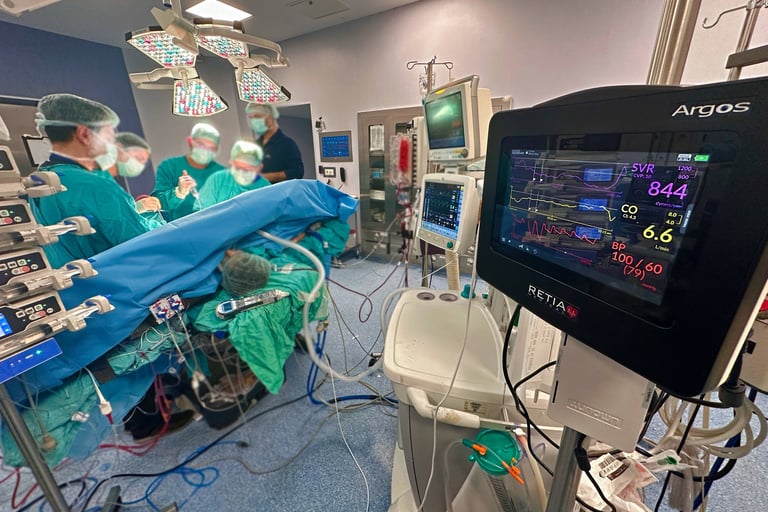

Argos Hemodynamic and Cardiac Output Monitor
RETIA Medical · Minimally invasive hemodynamic monitoring
Argos continuously monitors cardiac output and hemodynamic parameters using the patient's existing arterial line. By revealing changes in hemodynamic status early, it supports data-driven, patient-specific treatment in the operating room and ICU.
No additional consumables required
Setup in under 2 minutes
10 hemodynamic parameters on one screen
Why Argos?
Measured parameters
Videos
Frequently Asked Questions
What is cardiac output?
The volume of blood the heart pumps per minute, calculated as stroke volume × heart rate. In resting adults it is normally about 4–8 L/min.
What does a hemodynamic monitor do?
It continuously displays cardiac output, stroke volume, systemic vascular resistance and pulse pressure variation (PPV), helping clinicians tailor fluid and drug therapy in the OR and ICU.
What is minimally invasive cardiac output monitoring?
Continuous calculation of cardiac output from the pressure waveform of the existing arterial line, without a pulmonary artery catheter. Argos does this with its MBA™ algorithm.
Does the Argos cardiac output monitor require additional consumables?
No. Argos uses the patient's existing arterial line and transducer, so no patient-specific consumables are needed.
Which patient monitors is Argos compatible with?
It connects to any bedside monitor with a BP out (analog pressure output), such as Philips, GE, Mindray, Dräger, Nihon Kohden and Spacelabs.
How long does setup take?
It connects to the patient monitor with a single reusable cable and is ready to use in under 2 minutes.
Which patients is Argos indicated for?
Continuous cardiac output measurement in critically ill adult patients in the operating room and ICU.
How can I get a price?
Use the Request a Quote button on this page and the product name is filled in automatically; we reply within 24 hours.
Reliable cardiac output even in arrhythmia
Atrial fibrillation and other arrhythmias are among the most difficult situations for measuring cardiac output in the operating room and ICU. Because every beat differs in shape and duration, methods that analyze single beats are directly affected by this variability. Argos' MBA™ algorithm analyzes up to 20 beats together and uses the information in inter-beat variation.
Clinical studies
Technical documents in Turkish
Proven accuracy in difficult patient groups
Leading centers using Argos
What is cardiac output and how is it measured?
Cardiac output is the volume of blood the heart pumps per minute: stroke volume multiplied by heart rate (CO = SV × HR). In resting adults it is roughly 4–8 L/min; indexed to body surface area it is called cardiac index (CI), normally about 2.5–4.0 L/min/m².
Why does hemodynamic monitoring matter?
Blood pressure alone does not show whether tissues receive enough blood and oxygen. Tracking cardiac output, stroke volume and systemic vascular resistance helps tailor fluids, vasopressors and inotropes to each patient — especially in major surgery, cardiovascular surgery, septic shock and critical care.
Cardiac output measurement methods
Thermodilution (pulmonary artery catheter): Considered the reference method, but invasive and requires catheter placement.
Transpulmonary thermodilution: Requires a central venous catheter and a dedicated arterial catheter.
Echocardiography and Doppler: Non-invasive, but intermittent and operator-dependent.
Arterial pressure waveform analysis (minimally invasive): Continuous, real-time measurement from the arterial line the patient already has. Argos belongs to this group.
What makes Argos different
With its MBA™ (Multi-Beat Analysis) algorithm, Argos analyzes up to 20 beats together instead of each beat separately. This keeps cardiac output reliable even in arrhythmias such as atrial fibrillation, with no extra catheter or patient-specific disposables.
© 2026 Melitrone Teknolojik Sistemler Ticaret Limited Şirketi · All rights reserved.
We Are Happy to Help!
Fill out the form with your questions and our team will get back to you as soon as possible.